At a glance 本期概览
Today’s project: kids run a real science-fair experiment with paper planes, and AI is the lab assistant. 孩子是科学家:问题、猜想、动手实验、测量和结论都由孩子完成;AI 只帮忙想点子、解释原理、检查算术。
| Item 项目 | Details 内容 |
|---|---|
| Project 项目 | Paper Plane Science Lab 纸飞机科学实验室 |
| Domain 领域 | Science 科研(科学展项目:假设 → 实验 → 数据 → 结论) |
| Ages 年龄 | 4–8 Little Creators · 9–12 Junior Authors · 13–18 Teen Designers |
| Time 耗时 | 45–90 min (by age 按年龄) |
| English goals 英文目标 | Science words (question, hypothesis, variable, fair test, data, conclusion); “I think… because…” frames; presenting results out loud |
| AI literacy 认知目标 | AI can suggest ideas but cannot do the experiment; AI can be wrong, so data and grown-ups check it; asking “why?” well |
| Tools (China) 国内工具 | 豆包(家长账号,用来头脑风暴和解释原理)+ WPS 表格(画柱状图) |
| Tools (global) 海外工具 | Gemini(13 岁以下用 Family Link 受监管账号)或 ChatGPT(13+ 经家长许可)+ Google Sheets |
| Output 成果 | A data table, a bar graph and a one-page science-fair poster, presented by the child 孩子亲自讲解的实验海报 |
Safety first 安全规则(每期固定)
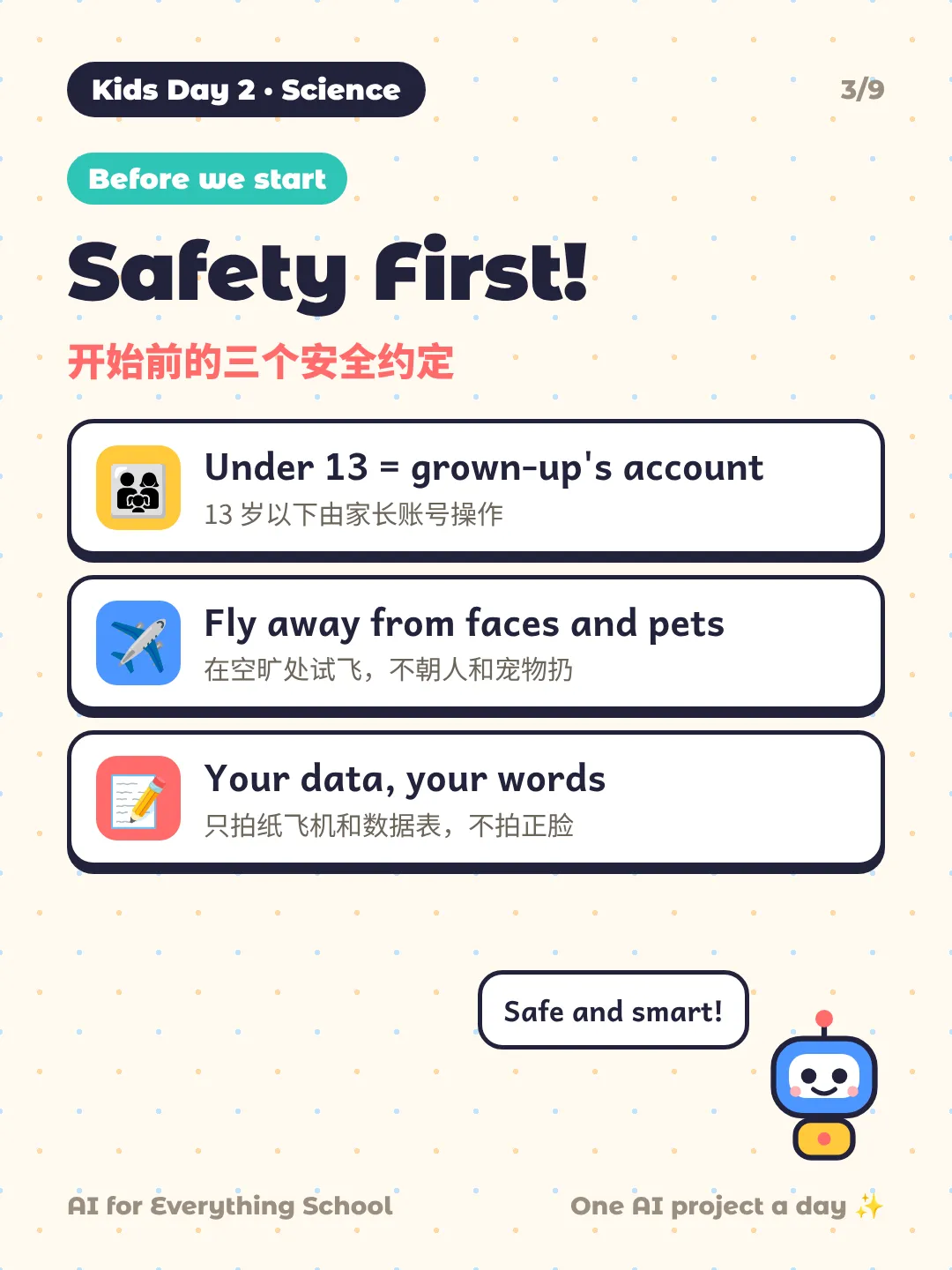
- Under 13: the parent holds the account and does the typing; the child is the lead scientist. ChatGPT 要求 13 岁以上,18 岁以下需家长许可;Gemini 为 13 岁以下提供家长通过 Family Link 开启的受监管账号(地区可用性以官方为准)。
- Fly planes in an open space, never at faces or pets. 在空旷处试飞,不朝人和宠物扔,纸飞机尖头可以折钝。
- Never upload a child’s face, full name, school or address. 只拍纸飞机和数据表,不拍孩子正脸。
- Your data, your words. 数据是孩子量的,结论是孩子写的;AI 的解释要和家长一起核对。
Language mix 语言比例: about 60% English, 40% Chinese. English carries the steps, science words and the kids’ lines; Chinese carries parent tips and explanations. 英文给孩子读,中文给家长看。
Three age tracks 三个年龄段
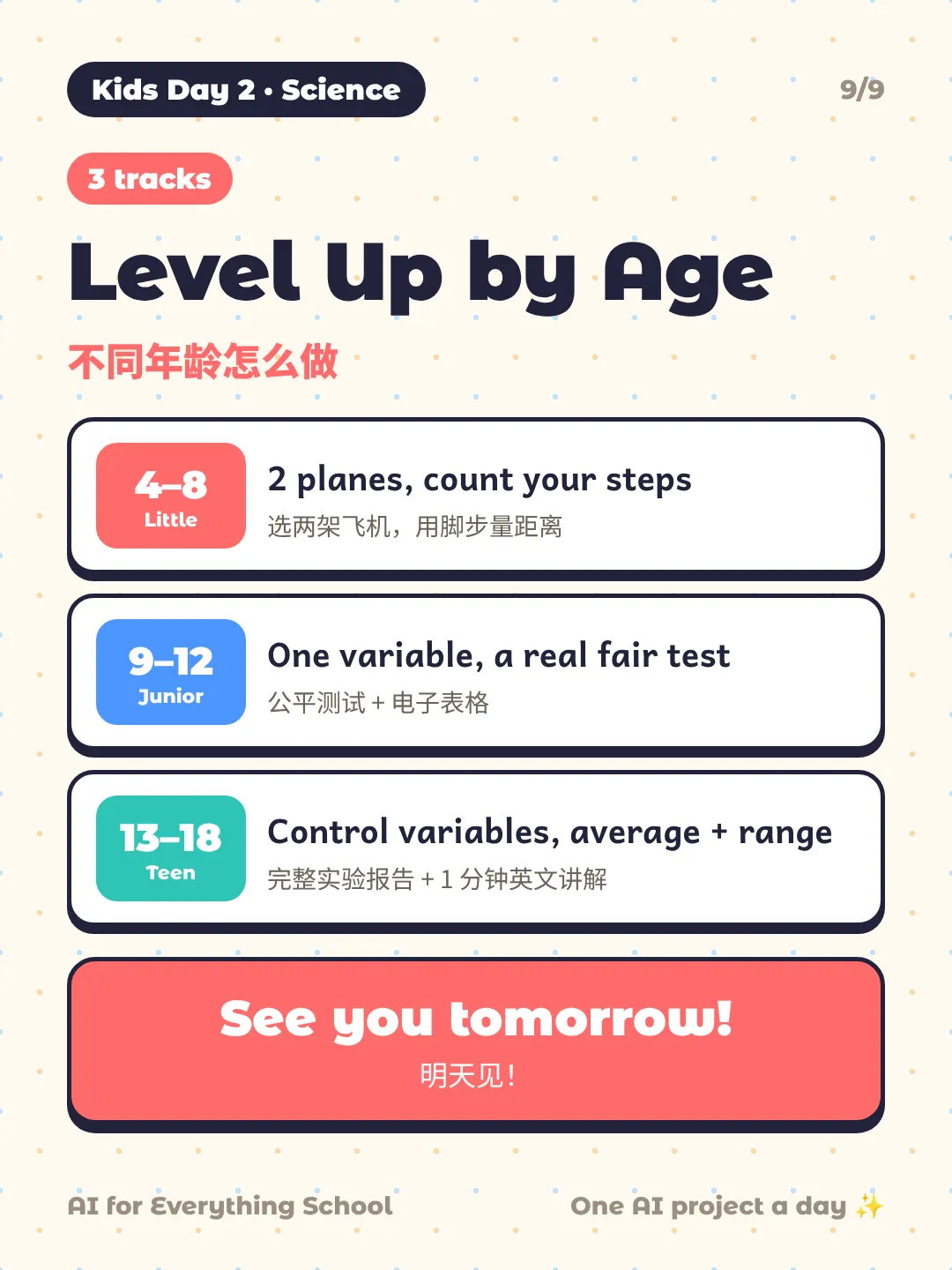
Same experiment, three levels: the older the child, the more they plan, measure and explain themselves. 同一个实验分三档,年龄越大,孩子自己设计、自己算、自己讲的越多。
| Little Creators 4–8 | Junior Authors 9–12 | Teen Designers 13–18 | |
|---|---|---|---|
| Who types 谁操作 | Parent 家长 | Parent, child dictates 家长打字,孩子口述 | Teen, parent checks 孩子操作,家长把关 |
| Child’s job 孩子做什么 | Pick 2 planes, guess the winner, throw and count steps 选两架飞机、猜谁赢、用脚步量距离 | Choose one variable, run a fair test, measure in metres 选一个变量、公平测试、用卷尺量 | Design the method, control variables, analyse averages and spread 设计方案、控制变量、分析平均值和波动 |
| Scale 规模 | 2 planes × 3 throws | 2–3 planes × 5 throws | 3 conditions × 5 throws × 2 testers |
| English per step 每步英文 | 1 short sentence 一句 | 2–3 sentences with frames 用句型写两三句 | A short report paragraph 一段实验报告 |
| AI does 交给 AI | Explain “why” in kid words 用儿童语言解释原理 | Suggest variables, quiz the child on the result 建议变量、追问结果 | Critique the method, check the maths, play science-fair judge 挑方案毛病、核算术、模拟评委提问 |
| Graph 图表 | Sticker bar chart on paper 贴纸柱状图 | Bar chart in WPS / Google Sheets 电子表格柱状图 | Bar chart with average + range 带平均值和极差 |
| Finish line 完成标准 | Says “I think… My test shows…” to family 给家人讲一句结论 | A poster with question, hypothesis, data, conclusion 完整海报 | Poster + 1-minute English talk + answers judge questions 海报+1 分钟英文讲解 |
| Time 耗时 | 45 min | 60 min | 90 min |
Step by step 分步教程
Step 1 · Ask a Question 提出问题(10–15 min)
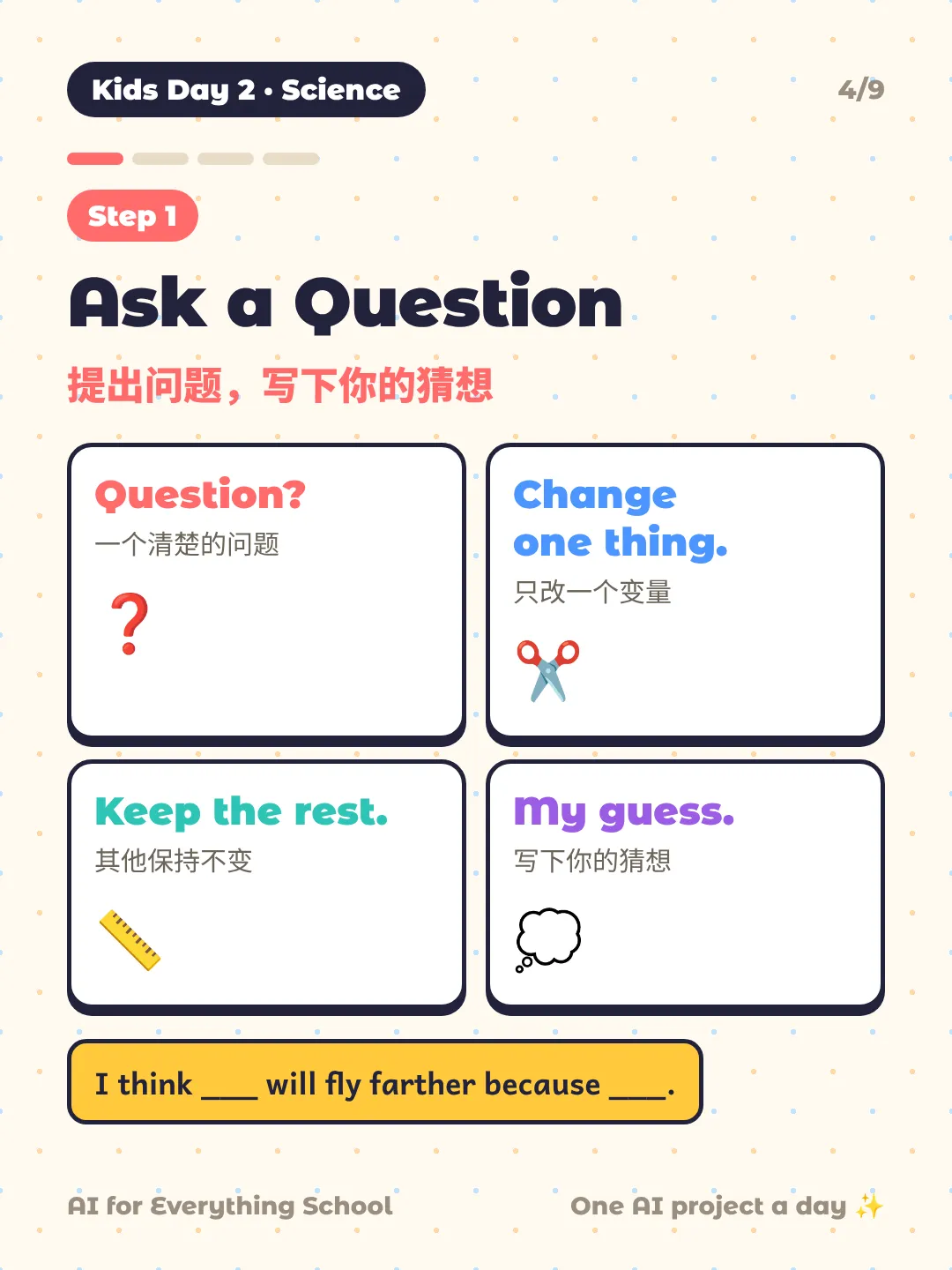
Why 为什么: A good experiment starts with one clear question. 好实验从一个清楚的问题开始。
How 怎么做:
- Fold one plane together. Then ask: “What could I change?” 先一起折一架,再问「我可以改什么?」
- Let AI suggest ideas, then the child picks ONE. 让 AI 提 3 个点子,孩子只选一个:翼展宽窄、机头加不加回形针、纸的厚薄。
- Write the hypothesis: “I think ___ will fly farther because ___.” 用句型写下猜想。
Done right 做对标准: One question, one thing to change, one written guess. 一个问题、一个变量、一句猜想。
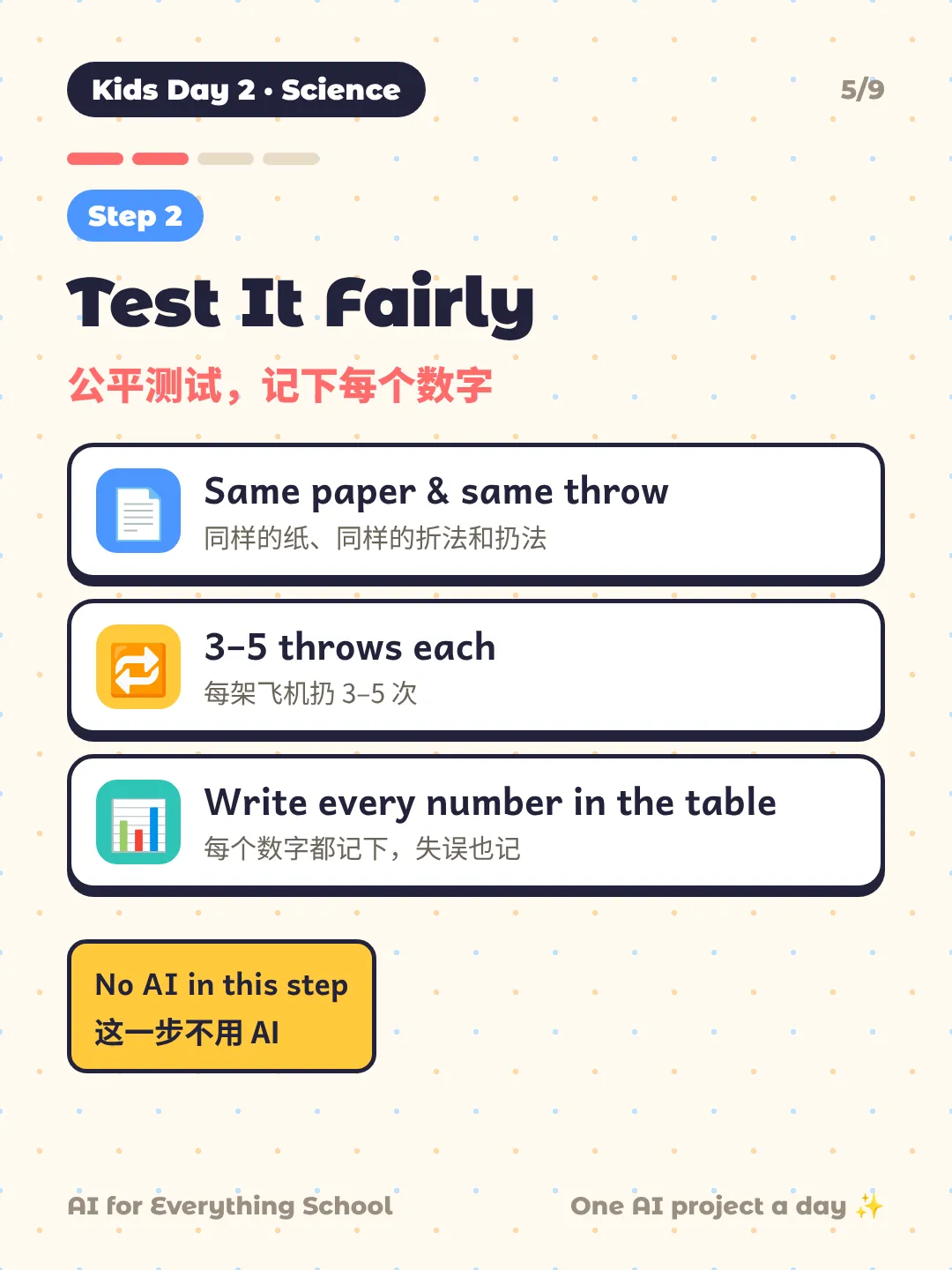
Step 2 · Test It Fairly 公平测试(15–30 min)
Why 为什么: If we change two things at once, we can’t tell which one made the difference. 一次只改一个东西,才知道是谁起了作用。
How 怎么做:
- Use the same paper and the same fold for every plane, except the ONE change. 同样的纸、同样的折法。
- Put tape on the floor as a start line. Throw the same way every time. 地上贴一条胶带当起飞线。
- Throw each plane 3–5 times. Measure with a tape measure (ages 4–8 count steps). 每架扔 3–5 次,小朋友可用脚步量。
- Write every number in the data table, even the bad throws. 每个数字都记下,失误也记。
No AI in this step. 这一步不用 AI——数据必须来自真实的实验。
Done right 做对标准: A full data table with at least 3 throws per plane. 每架至少 3 个数字。
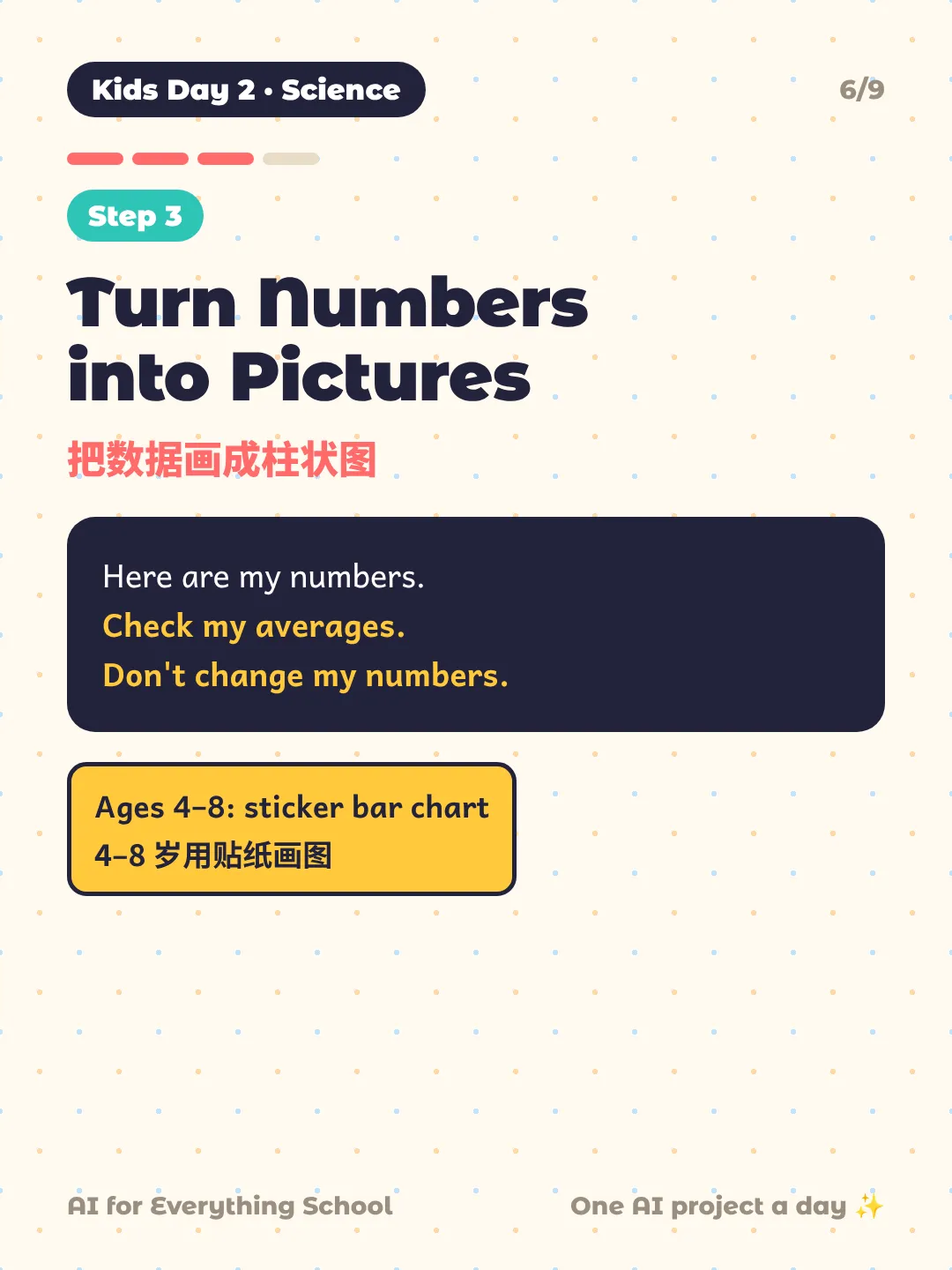
Step 3 · Turn Numbers into Pictures 把数据画成图(10–20 min)
Why 为什么: A graph lets everyone see the answer in one second. 柱状图让结果一眼就能看懂。
How 怎么做:
| 4–8 | 9–12 | 13–18 | |
|---|---|---|---|
| Make the graph 画图 | One sticker = one step, stack them 一个贴纸代表一步 | Type the numbers into WPS 表格 / Google Sheets, insert a bar chart | Chart averages; show the shortest and longest throw |
| Maths 算术 | Which bar is taller? 哪根更高 | Find the average with a parent 和家长一起算平均 | Average + range, by hand first 先手算 |
| AI’s job AI 做什么 | None 不用 | Check our averages 核对平均值 | Check maths, point out odd data 核算术、指出异常值 |
Prompt idea 提示词:“Here are my numbers. Check my averages. Don’t change my numbers.” 先自己算,再让 AI 核对;AI 算错也是一堂课。
Done right 做对标准: A labelled bar graph: title, plane names, distance in metres (or steps). 图表有标题、有单位。
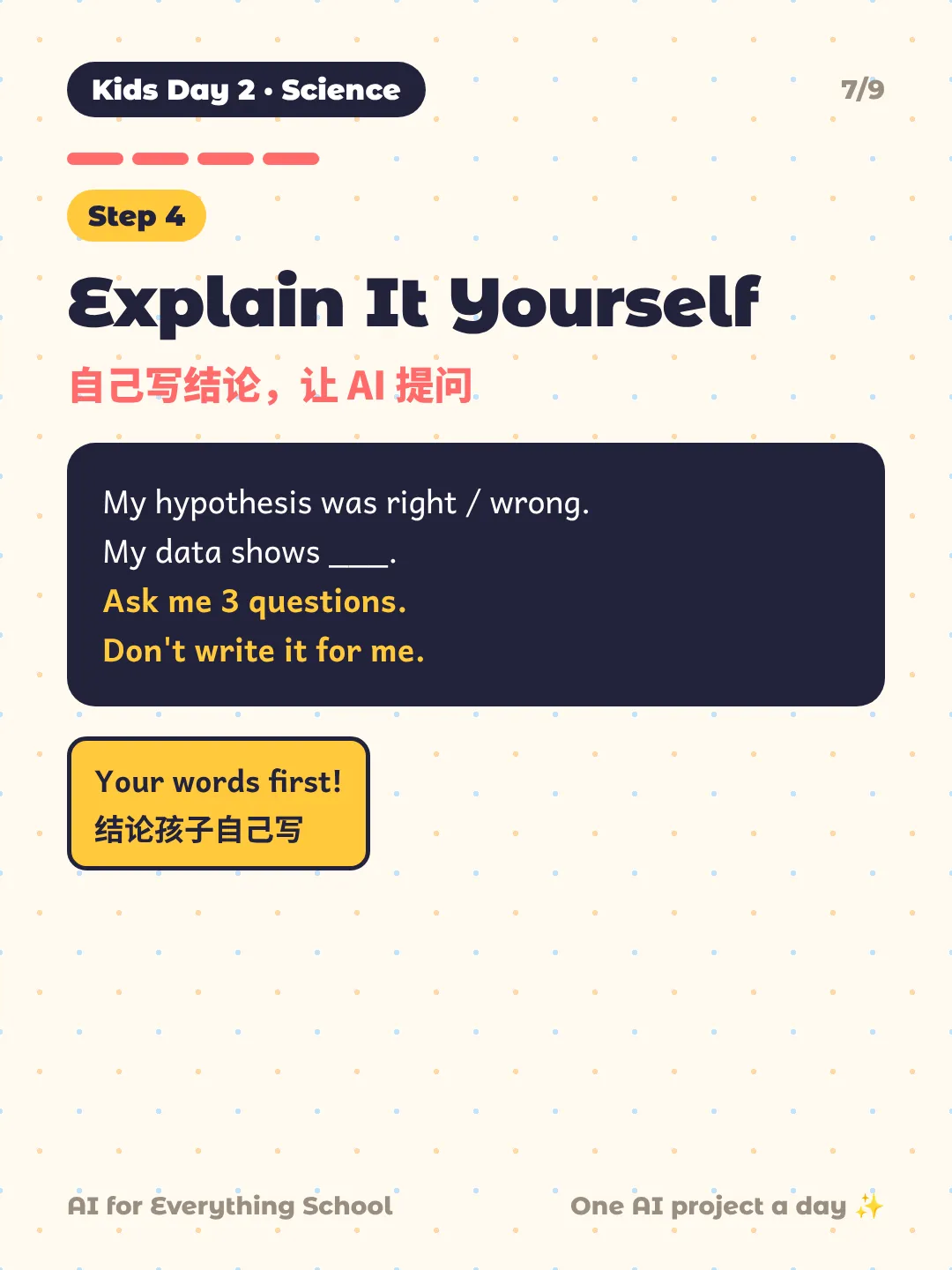
Step 4 · Explain It Yourself 自己写结论(10–20 min)
Why 为什么: Scientists explain what they found and why. 科学家要讲清楚发现了什么、为什么。
How 怎么做:
- The child writes the conclusion first: “My hypothesis was right / wrong. My data shows ___.” 结论孩子先写。
- Ask AI to be a science-fair judge: it asks 3 questions, the child answers. 让 AI 扮演评委提问,不让它代写。
- Ask AI “Why?” and learn one new idea: drag (阻力), lift (升力), weight (重力). Check it in a book or with a grown-up.
- Make a one-page poster: Question · Hypothesis · Method · Data · Conclusion. 做一张单页海报,给家人讲一遍。
Parent tip 家长提示:猜错了是好事。「My hypothesis was wrong」是科学家最常说的话之一,请把它当成发现来夸。
Done right 做对标准: The child presents the poster in their own words. 孩子用自己的话讲完整张海报。
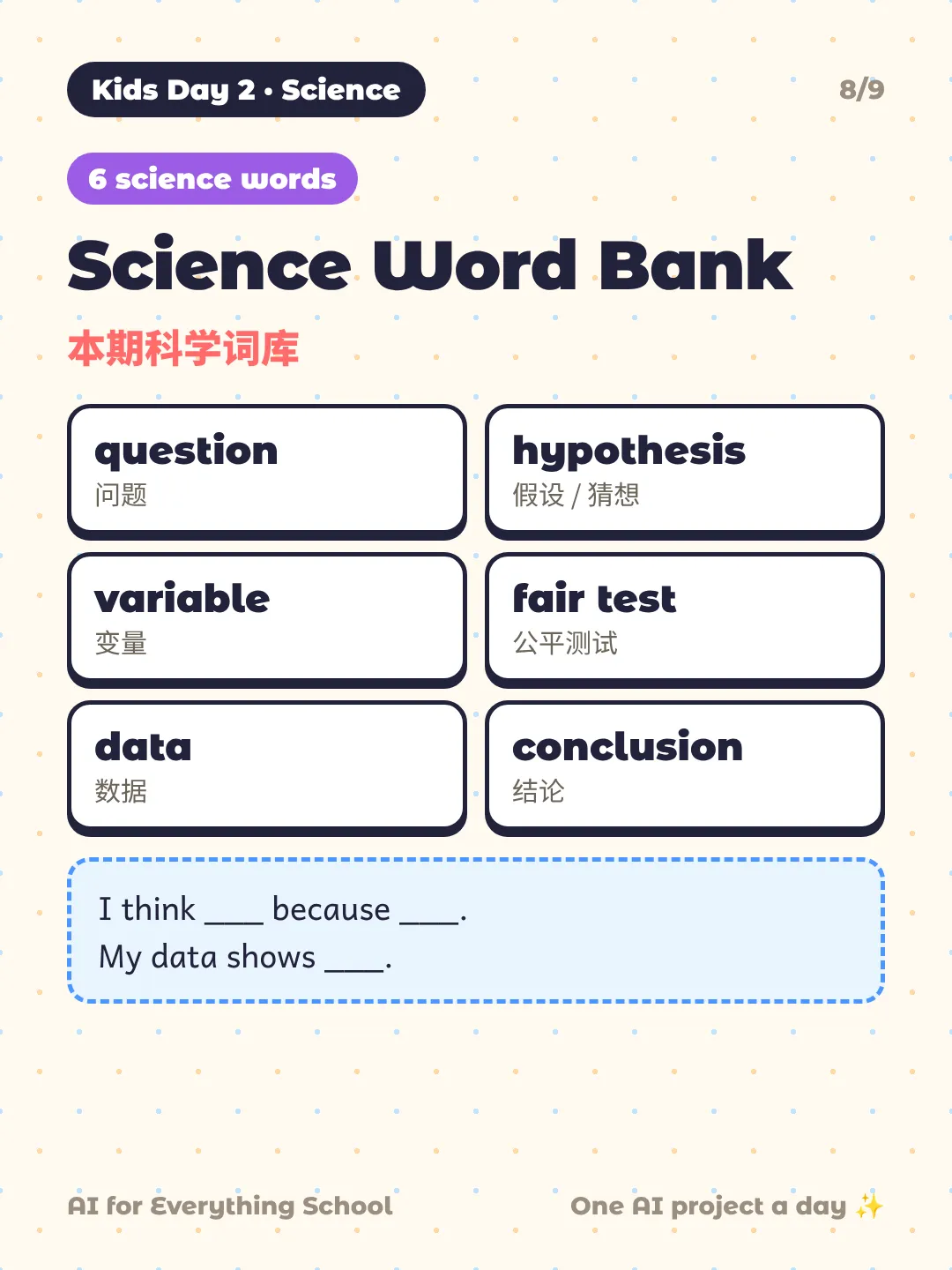
Word Bank 词库
| Word | 中文 | Use it 例句 |
|---|---|---|
| question | 问题 | My question is: which plane flies farther? |
| hypothesis | 假设 / 猜想 | I think the long-wing plane will fly farther. |
| variable | 变量 | I changed only one variable: the wings. |
| fair test | 公平测试 | It was a fair test, so I used the same paper. |
| data | 数据 | My data shows the long-wing plane won. |
| conclusion | 结论 | My conclusion is that bigger wings help. |
Think about it 想一想
When your child finishes, ask: “Which part was your idea, and which part did AI help with? Could AI have found your answer without your throws?” 哪部分是你的创意?哪部分是 AI 帮的?没有你亲手扔的那些数字,AI 能知道答案吗?
Toolkit 附录
Prompt cards by age 分龄提示词卡
Little Creators 4–8 (parent types 家长输入):
My child is 6. We threw two paper planes. The [pointy plane] flew [8] steps and the [wide plane] flew [5] steps.
Explain in 3 very short, simple sentences why one plane might fly farther.
Do not tell us the answer is certain. Ask my child one fun question at the end.
Junior Authors 9–12:
I am 10 and I'm doing a paper plane science fair project.
Step 1: Give me 3 things I could change to test (one variable each). Don't choose for me.
Later: Here is my data: [plane A: 3.2, 3.8, 3.5 m] [plane B: 2.1, 2.6, 2.4 m].
Check my averages. Don't change my numbers.
Then ask me 3 questions a science fair judge might ask. Wait for my answers.
Teen Designers 13–18:
I'm 15 and designing a paper plane experiment. My question: [does wing area change flight distance?]
Critique my method: what variables am I not controlling? How many trials do I need?
Here is my data table: [paste]. Check my averages and ranges, and flag any outliers. Don't write my conclusion.
Act as a strict science fair judge: ask me 5 hard questions, one at a time.
Sentence frames 句型支架
- My question is: ___?
- I think ___ will fly farther because ___.
- I changed only one thing: ___. I kept ___ the same.
- Plane A flew ___ metres on average. Plane B flew ___ metres.
- My hypothesis was right / wrong. My data shows ___.
- Next time, I want to test ___.
Lab worksheet 实验学习单
| Part | My answer 我的答案 |
|---|---|
| Question 问题 | |
| Hypothesis 猜想 (I think… because…) | |
| The ONE thing I change 我改变的变量 | |
| Things I keep the same 保持不变的 | |
| Plane A: throw 1 / 2 / 3 / 4 / 5 | |
| Plane B: throw 1 / 2 / 3 / 4 / 5 | |
| Average 平均值 (A / B) | |
| Conclusion 结论 | |
| My idea vs AI’s help 我的创意 / AI 帮的 |
Safety checklist 家长安全清单
- Under 13: parent’s account, parent types 家长账号操作
- Plane noses folded blunt; open space, no throwing at faces or pets 机头折钝、空旷处试飞
- No photos of faces, full names, school or address uploaded 不上传个人信息
- Every number comes from a real throw, not from AI 数据全部来自真实实验
- AI’s science explanations checked together 原理解释一起核对
- AI used as a tool, then closed — not as a chat buddy 用完就关,不当陪聊
- Shared online: graph and poster only, nickname only 发布只用图表和昵称
Common problems 常见问题
| Problem 问题 | Fix 解决 |
|---|---|
| AI just tells the answer AI 直接给答案 | Add “Don’t tell me the answer. Help me test it.” |
| Numbers jump around a lot 数字差很多 | Practise throwing first; do 5 throws; same person throws |
| Changed two things at once 同时改了两样 | Fold a new pair; only one difference between them |
| AI’s maths is wrong AI 算错 | Great lesson! Check it by hand together 一起手算验证 |
| Hypothesis was wrong 猜错了 | That’s real science. Write “My hypothesis was wrong” proudly |
| Child loses interest 孩子没耐心 | Experiment today, graph and poster tomorrow |
Sources
- Google Gemini Help: Gemini Apps for children under 13 (Family Link)
- ESET: Is ChatGPT safe for kids? (age 13+, parental consent, parental controls), Nov 2026
- AIbase:豆包上线未成年人保护模式
- Science Buddies: How far will paper planes fly? (drag experiment, grades 1–3)
- OpenAI Help:使用 ChatGPT 进行数据分析(上传表格、生成图表,可用性因套餐而异)
- CSDN:国内大模型上传 Excel 做数据分析测评(2024,功能可能已变化,以官方为准)
- AI工具集:WPS 多维表格 AI 评测(2026-09)
Note 说明:各工具的免费额度、会员价格和 AI 画图功能以官方为准;本项目的柱状图用 WPS 表格 / Google Sheets 的普通「插入图表」即可,不依赖 AI 功能。